

AI interview outsourcing
Interview as a service. Done 24/7.
Structured candidate interviews and evidence-backed scorecards, so your team only meets qualified people.

Quick answer
What is interview as a service?
Interview as a service is a model where a specialist platform conducts defined interview rounds for your company and returns structured evaluation evidence. You set the role requirements and keep the hiring decision. IntervueBox uses AI interviewers to deliver those rounds on demand, at scale, with a consistent rubric.
In practical terms, it is interview outsourcing without the usual calendar dependency. Instead of asking recruiters, engineers or external panelists to repeat the same screening conversation, your team defines what good looks like once. Candidates then complete a structured interview, and reviewers receive comparable scorecards, recordings, transcripts and integrity signals. Human time moves toward calibration, candidate relationships and final judgment.
The interviews run on the same AI Interviewer that powers the IntervueBox platform, and the stage slots into the workflow described on how it works. Teams that prefer to see it before reading further can sit a live five-minute interview on the tour.
Last reviewed: September 10, 2026
A complete interview service, not another scheduling tool
The service covers the work between a role brief and a decision-ready interview report.
Design the interview
Start with the role, seniority, responsibilities and competencies that matter. IntervueBox turns them into a structured interview plan with consistent questions, scoring dimensions and pass criteria. Your team can use its own question bank or adapt a reusable template. The goal is not to remove your hiring judgment. It is to make sure every candidate reaches that judgment through the same documented route.
- Role-specific competencies and configurable rubrics
- Your questions, reusable templates and adaptive follow-ups
Conduct every interview
Candidates complete an AI-led video interview when it suits them, including outside office hours and across time zones. The interviewer follows the agreed structure, listens to each response and asks relevant follow-up questions. Multiple candidates can interview at the same time, so campaign volume no longer depends on the number of panelists who happen to be free that week.
- On-demand interviews available 24/7 in 50+ languages
- Concurrent delivery for one role or a high-volume campaign
Return decision-ready evidence
When a session ends, the hiring team receives a structured report rather than another recording to watch from the beginning. Competency scores, answer summaries, evidence moments and integrity signals sit together in the candidate record. Recruiters can compare candidates on a shared standard, route qualified people forward and keep the final decision in human hands.
- Evidence-backed scorecards and ranked candidate reports
- Recordings, transcripts, integrity flags and next-step workflows
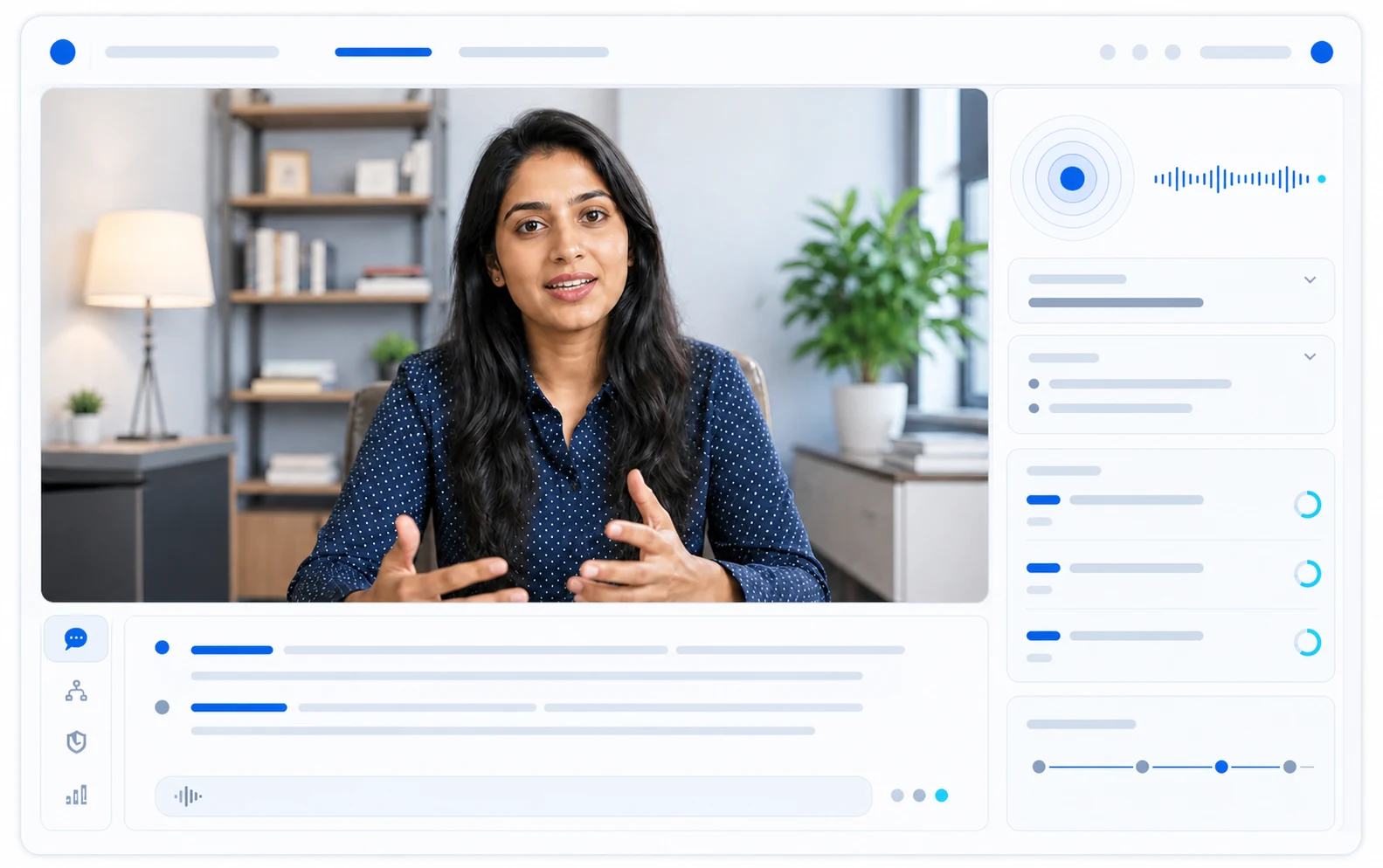
Configured around your hiring bar
Generic interview services often promise consistency by forcing every employer into the same questionnaire. IntervueBox standardizes the method while keeping the content role-specific. Your team can define competencies, questions, weighting and pass criteria for each position, then reuse the approved plan across the whole candidate pool.
This separation matters. The platform handles reliable execution, but your organization remains responsible for the standard being measured. A sales role can emphasize discovery and objection handling, a support role can emphasize empathy and resolution, and an engineering role can combine technical reasoning with communication. The service scales your process rather than flattening every role into one test.
How outsourced interviews work with IntervueBox
A useful interview service should make ownership obvious. Your team controls the bar and the decision. IntervueBox controls repeatable delivery, documentation and the handoff between stages.
See the full platform workflowShare the role and hiring bar
Provide the job description, must-have skills, seniority, evaluation priorities and any knockout criteria. We translate the brief into a consistent interview structure. Teams with an established competency framework can preserve it; teams starting fresh can configure a clear rubric without rebuilding the process for every requisition.
Related: Inbuilt ATS · How the platform works
Review the interview plan
Your recruiting and hiring stakeholders confirm the questions, scoring dimensions, interview length and candidate instructions before launch. This calibration matters because a scalable interview service should reproduce your standard, not invent a new one after candidates are already in the funnel.
Related: AI Interviewer
Invite candidates at any volume
Send interview links from the IntervueBox workflow or connect the stage to your existing hiring process. Candidates can choose a suitable time and complete the session from a supported browser. Because AI conducts the interview, several people can be evaluated concurrently without creating panel conflicts or long scheduling queues.
Related: WhatsApp Agent · Candidate experience
Evaluate answers and integrity signals
Each response is assessed against the approved rubric. Adaptive follow-ups test depth, clarity and consistency instead of treating the interview as a fixed questionnaire. Proctoring and integrity analysis surface suspicious behavior for review, while recordings and transcripts preserve the context behind each conclusion.
Related: How AI interviewers detect cheating
Advance the right candidates
Recruiters and hiring managers review comparable reports, inspect the evidence behind a score and decide who moves forward. Qualified candidates can continue to human interviews, assessments or scheduling. The service handles repetitive evaluation at the top and middle of the funnel while your team retains ownership of the final hiring decision.
Related: AI Assessments · Interview Assistant for live rounds
From conversation to reviewable evidence
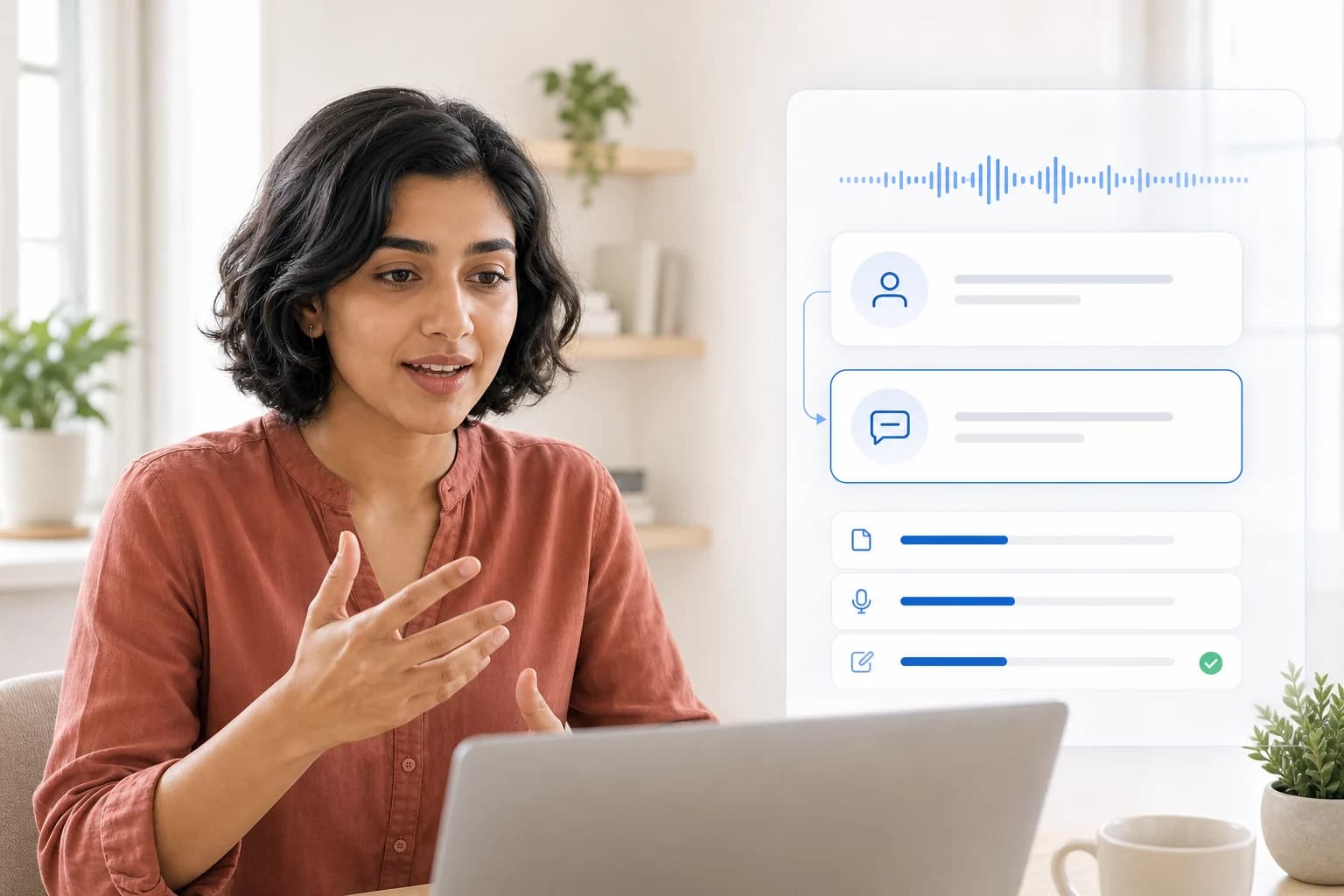
Interview outsourcing creates value only when the output helps someone make a better decision. IntervueBox does not stop at a completed video. The platform organizes the interview into competency scores, answer summaries and evidence moments that a reviewer can inspect quickly. Recordings and transcripts preserve the complete context when a hiring manager wants to go deeper.
This gives talent teams a shared language for comparison. Instead of reconciling one interviewer’s shorthand with another person’s memory, reviewers start from the same rubric and can trace conclusions back to the candidate’s response. The report supports judgment; it does not hide the conversation behind a single score.
- Per-competency scoring against the approved rubric
- Answer summaries linked to supporting interview evidence
- Recordings and transcripts for review and calibration
- Ranked results that help teams prioritize the next conversation
Interview services for technical and non-technical hiring
Use one governed delivery model across different roles, then configure the evidence each role needs.
First-round screening interviews
Verify role fit, relevant experience, communication, motivation, availability and practical constraints before a hiring manager invests time. This is useful when application volume is high or recruiter bandwidth is limited.
AI candidate screening in five stepsTechnical screening interviews
Assess engineering fundamentals, coding approach, debugging, system thinking and technical communication. For a deeper treatment of coding and engineering workflows, see our technical interview as a service guide.
Explore technical interview servicesFunctional and domain interviews
Configure structured interviews for sales, customer support, finance, operations, healthcare, retail and other functions. The rubric can focus on job-specific judgment rather than relying on the same generic questions for every role.
Pair with role-specific assessmentsBehavioral and competency interviews
Evaluate communication, ownership, collaboration, learning agility and decision-making through consistent prompts and evidence-linked scoring. A shared structure makes candidate comparisons easier to explain and audit.
The STAR method in video interviewsCampus and high-volume interviews
Give every eligible applicant a consistent opportunity without assembling a large temporary panel. Concurrent interviews help graduate, seasonal, frontline and multi-location campaigns move quickly while preserving a common standard.
Campus hiring softwareMultilingual interview programs
Run one governed process across regions while allowing candidates to communicate in a supported language. This reduces the need to source matching interviewer capacity for every language and time zone.
See the AI InterviewerIn-house panels, human outsourcing or AI-led interview services?
All three models can belong in the same hiring process. The right choice depends on whether a stage needs repeatable capacity, a named specialist or direct interaction with the future team. This comparison focuses on operating differences, not a claim that one method should run every interview.
| Criterion | In-house panel | Human interview outsourcing | IntervueBox AI-led service |
|---|---|---|---|
| Availability | Limited by recruiter and hiring-manager calendars | Limited by the vendor interviewer pool and matching time | On demand, 24/7, with concurrent interview capacity |
| Consistency | Varies by interviewer preparation, style and fatigue | Improves with calibration but can still vary by panelist | The approved rubric and structure apply to every candidate |
| Cost behavior | Hidden in employee time, delayed work and coordination | Usually grows with each interview and interviewer hour | Software-led delivery reduces dependence on human hours |
| Evidence | Often relies on notes written after the conversation | Depends on the provider's report format and documentation | Scorecards connect conclusions to recordings and transcripts |
| Candidate speed | Reschedules can add days between application and screening | Faster than building an internal panel, but calendars still matter | Candidates interview when ready, including outside office hours |
| Best use | Final judgment, team fit and relationship-building | Specialist interviews where a named human expert is required | Repeatable first rounds and structured interviews at scale |
Where AI-led IaaS fits best
Choose AI-led interview as a service when interview demand is repetitive, time-sensitive or too large for available panels. It is strongest when the stage has a clear purpose and an explicit rubric: initial qualification, competency screening, structured functional interviews, technical screens, campus rounds or multilingual volume. The value comes from concurrency, consistent execution and faster access to comparable evidence.
Where human interviews stay essential
Keep humans close to decisions that depend on team chemistry, executive context, confidential business judgment or specialist expertise that cannot yet be represented reliably in a rubric. A hybrid design is usually stronger than a total replacement claim. Let the service handle repeatable evidence collection, then give recruiters, managers and experts more time for the conversations only they can conduct.
Weighing a named provider? Side-by-side pages: InCruiter, Intervue.io, Interviewer.ai and Hyring, or the full comparison index.
Who benefits from interview outsourcing?
Engineering teams protecting build time
When senior engineers repeatedly run initial screens, the visible cost is calendar time and the larger cost is interrupted product work. Interview outsourcing moves repeatable technical qualification earlier, so engineers meet a smaller set of candidates with stronger evidence. Final architecture, collaboration and team-fit conversations can stay with the people who will work with the hire.
Related: Technology and IT recruitment · Technical interview as a service
Talent teams with unpredictable hiring demand
Internal capacity is usually sized for average demand, not sudden expansion, seasonal campaigns or a new location. An interview as a service platform gives recruiting teams elastic interview capacity without recruiting and training temporary interviewers each time volume changes.
Related: Talent acquisition software · Lateral hiring
Staffing and RPO firms managing client volume
Agencies can standardize early evaluation across recruiters and client accounts while preserving each client's role requirements. Whitelabel delivery and a shared evidence model help teams present qualified candidates with a consistent report rather than a collection of differently written screening notes.
Related: Staffing and RPO software · RPO case study
Distributed and multilingual organizations
Regional teams often use different interview questions, rating scales and documentation habits. A governed interview service creates one evaluation framework across locations while supported languages and around-the-clock availability reduce time-zone friction for candidates.
Related: KPO and BPO recruitment · Business hiring software
High-volume frontline and campus hiring
Large candidate pools create a difficult choice between slow screening and shallow screening. Concurrent AI interviews let each candidate complete a structured conversation, not only a short form, while recruiters focus on review, candidate care and final decisions.
Related: Fresher hiring · Campus hiring · Retail recruitment
Quality, fairness and interview integrity
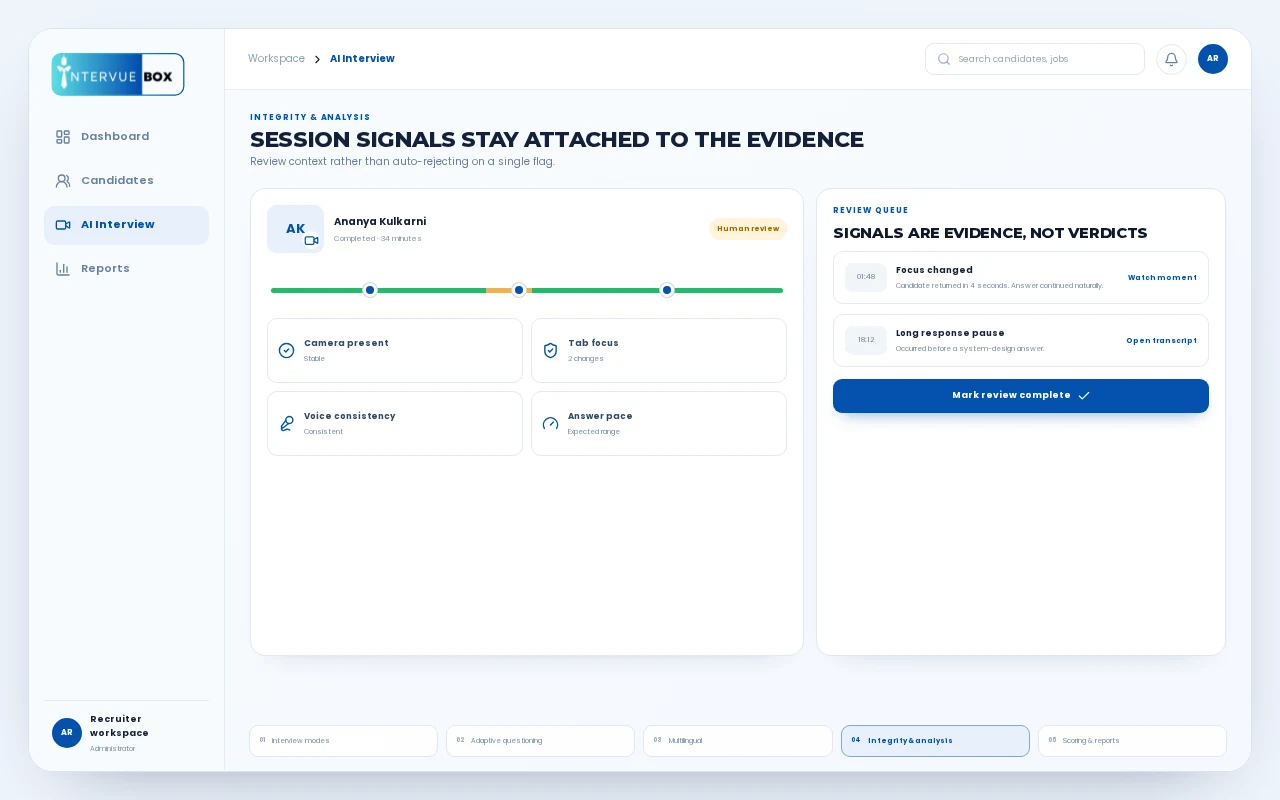
A credible outsourced interview process needs more than speed. It must show what was measured, apply the same standard to comparable candidates, preserve evidence and make exceptions visible to a reviewer. That is why IntervueBox combines structured rubrics, adaptive questioning, recordings, transcripts and integrity analysis in one candidate record.
AI proctoring can surface suspicious behavior, but a flag should be reviewed in context rather than treated as an automatic rejection. Likewise, a model-generated score should never become a hidden final decision. Your team can inspect the underlying answer, review the full session, calibrate outcomes and decide what additional evaluation is appropriate. This human-in-the-loop design keeps governance connected to actual hiring work.
Structure before automation
Automation does not rescue a vague interview. Define the competencies, behavioral anchors and evidence required for a pass before inviting candidates. That shared rubric should be visible to the people reviewing results and should remain stable during a hiring batch unless a documented calibration issue appears.
Evidence before a recommendation
A score is useful only when a reviewer can understand why it was assigned. IntervueBox keeps recordings, transcripts and response evidence connected to the report so a hiring manager can inspect the important moments instead of accepting an unexplained label.
Comparable treatment for every candidate
Each person should face the same competency framework, interview conditions and evaluation logic for the same role. Adaptive follow-ups can respond to what a candidate says, but the scored dimensions stay consistent. That balance preserves a natural conversation without abandoning comparability.
Humans retain the decision
The service organizes evidence and recommends next steps. Your organization decides who advances, what additional review is needed and who is hired. Teams can sample reports, review flagged sessions and keep human-led rounds wherever context, relationship-building or specialist judgment matters most.
What to check before choosing an interview service
Provider pages often sound similar, so evaluate the operating details. Ask how the interview plan is created, who owns calibration, how results are explained and where candidate data moves. Request a sample report. A good scorecard should help a hiring manager understand the candidate, not merely prove that an interview occurred.
Also compare the complete cost of the model. A low per-interview price may still carry coordination work, panel delays or minimum commitments. A software-led service may reduce delivery dependency, but it still requires thoughtful setup and review. The useful question is not only, “What does one interview cost?” It is, “How much qualified evidence can our team produce, how quickly, and with how much internal effort?”
Report quality
Can reviewers trace every important conclusion to a candidate response?
Workflow fit
Can invitations, reports and next actions connect to the system your team uses?
Governance
Who controls rubrics, calibration, overrides, retention and hiring decisions?
Security
Are access, consent, compliance and data-handling responsibilities documented clearly?
Coverage
Do supported roles, languages, locations and time zones match your hiring plan?
Technical depth
Can the service test reasoning and practical work, not only keyword recall?
A practical rollout for your first outsourced interview stage
Start with one measurable bottleneck, calibrate it with the people who own the role, then expand from evidence.
Choose the right interview stage
Begin with a repeatable stage where volume is high and the evaluation standard can be written clearly. First-round screening is often the strongest starting point. Keep highly contextual final conversations with the hiring team until the evidence shows where the service adds value.
Related: One-way video interviews
Define success before launch
Track time from application to interview, completion rate, reviewer turnaround, advancement quality, candidate feedback and the internal hours returned to recruiters or subject-matter experts. A pilot should answer whether decisions became faster and more consistent, not only whether more interviews were completed.
Related: Hiring cost calculator
Calibrate with real examples
Review a small set of reports with hiring managers and compare outcomes with your current process. Use disagreements to clarify the rubric, strengthen behavioral anchors or change the follow-up logic. Calibration is a practical governance step, not a one-time software setting.
Related: Customer case studies
Prepare candidates clearly
Explain the format, expected duration, device requirements, data handling and support path in the invitation. Candidates should know they are speaking with an AI interviewer and understand how the session will be evaluated. Clear expectations improve completion and reduce avoidable support questions.
Related: Candidate experience platform
Connect the next action
Decide who reviews reports, what score or evidence triggers a closer look and how qualified candidates move to the next stage. The best interview services remove waiting between stages. A fast interview followed by an unowned report queue simply moves the bottleneck downstream.
Related: Inbuilt ATS · Integrations and features
Keep technical search intent focused
This page covers interview as a service across roles and interview types. If your immediate goal is to outsource coding, debugging, system-design or engineering screens, our dedicated technical interview as a service page explains that workflow in more depth. Keeping the subjects separate helps hiring teams find the right detail and prevents broad interview services content from burying technical requirements.
Read the technical interview guideFurther reading
Guides that go deeper
- Unleashing the power of customised interview servicesWhy a rubric built for your role beats a generic questionnaire.
- AI interviews vs human recruiter screensCompetition or collaboration, and where each one wins.
- AI-led vs AI-assisted interviewsThe difference that decides what gets outsourced.
- Calculating the ROI of AI video interviewsA practical way to cost an outsourced interview stage.
Interview as a service FAQs
Direct answers for teams comparing interview services, interview outsourcing companies and AI-led delivery models.
What is interview as a service?
Interview as a service is a delivery model in which an external platform or provider conducts defined interview stages for an employer and returns structured evaluation results. The employer supplies the role requirements and retains the hiring decision. IntervueBox uses AI interviewers to run repeatable first-round, technical, functional and behavioral interviews on demand, then provides evidence-backed scorecards, recordings and transcripts for human review.
Related: How IntervueBox works
How does IntervueBox interview as a service work?
Your team shares the job description, competencies, questions and scoring standard. IntervueBox configures the interview, candidates receive an invitation and complete the AI-led session when convenient, and the platform evaluates answers against the agreed rubric. Recruiters and hiring managers then review the scorecard and supporting evidence, decide who advances and continue qualified candidates through their existing hiring process.
Is interview as a service the same as interview outsourcing?
The terms overlap because both move interview execution outside the employer's internal panel. Traditional interview outsourcing commonly assigns a human interviewer for each session. An AI-led interview as a service platform delivers the same operational outcome through software, which enables 24/7 availability, concurrent interviews and a consistent rubric. Companies can also use a hybrid model: AI for repeatable screening and internal or external experts for final specialist rounds.
Related: AI-led vs AI-assisted interviews
What types of interviews can be outsourced?
Teams can outsource first-round screening, technical screening, functional interviews, behavioral and competency interviews, campus interviews, multilingual interviews and other repeatable stages with a clearly defined rubric. Final executive, team-fit or highly specialized interviews may remain human-led. The right boundary depends on the role, risk level and the context your organization needs to evaluate directly.
Is IntervueBox a one-way video interview platform?
IntervueBox supports asynchronous video hiring, but the experience is more than a one-way video interview platform that records answers to fixed prompts. Its AI interviewer listens to each response, asks relevant follow-up questions and evaluates the complete conversation against a role-specific rubric. Teams can use this AI interview software as the interview stage in a broader video interview program, then send qualified candidates to live recruiter, manager or specialist rounds.
Related: One-way video interviews · Video interview software
How is an interview service different from a hiring test platform?
A hiring test platform usually scores predefined questions, work samples or coding tasks. An interview service conducts a structured conversation and can probe how a candidate explains experience, judgment and reasoning. The two are complementary when screening candidates for recruitment: an assessment can show what someone produces, while the AI-based interview platform explores how they reached an answer and returns evidence for human review.
Related: AI Assessments
Can interview services assess technical candidates?
Yes. IntervueBox can combine structured technical questions, adaptive follow-ups and coding assessments to evaluate problem-solving, fundamentals, debugging, system thinking and communication. Results are returned in the same candidate record. Teams hiring engineers can visit the technical interview as a service page for a detailed view of supported workflows and the recommended AI-screen, engineer-final model.
Related: Technical interview as a service
How quickly can candidates complete an interview?
AI-led sessions are available on demand, 24/7, so candidates do not need to wait for a matching panel calendar. The exact completion time depends on the interview length your team configures. Once a session finishes, scoring and the structured report are available without a separate interviewer-note or reviewer queue, allowing the hiring workflow to continue sooner.
How are outsourced interviews kept consistent and fair?
Consistency starts with a role-specific rubric and clear scoring anchors. The same competencies, core structure and evaluation logic apply to every candidate for that role. Adaptive questions can probe an individual answer, but they do not change what is being measured. Reviewers can inspect recordings, transcripts and evidence moments, and your team can calibrate or override decisions rather than treating an automated score as unquestionable.
Related: AI video interviews and hiring bias
How does IntervueBox address interview integrity?
IntervueBox includes AI proctoring and integrity analysis that can flag suspicious session behavior for human review. Adaptive follow-up questions also make it harder to rely on memorized responses because candidates must explain their reasoning in context. Integrity signals are part of the evidence, not an automatic hiring verdict. Your reviewers decide what a flag means under the organization's policy and the role's risk level.
Related: How AI interviewers detect cheating
Does interview as a service replace recruiters and hiring managers?
No. It replaces repetitive interview execution and coordination where a structured stage can be defined clearly. Recruiters still design the candidate journey, communicate with people and manage the process. Hiring managers still set the bar, review evidence and make decisions. Subject-matter experts can spend their limited interview time on finalists, deeper judgment and the conversations that help both sides decide whether to work together.
Can the service work with our ATS and existing hiring process?
Yes. IntervueBox includes an inbuilt Agentic ATS and can also connect results to an existing ATS or HRMS through integrations and webhooks. The practical goal is to place the interview report, status and next action where recruiters already work. During setup, define the invitation trigger, report owner, advancement rule and scheduling handoff so the service becomes a stage in the workflow rather than another disconnected tool.
Related: Inbuilt ATS · Platform features
Which languages does IntervueBox support?
IntervueBox supports interviews in more than 50 languages. This helps organizations run a common evaluation process across regions while allowing candidates to communicate in a supported language. Language availability for a particular use case should still be confirmed during setup, especially when the interview depends on specialized terminology, role-specific communication standards or local policy requirements.
Related: AI Interviewer
How should we compare interview as a service providers?
Compare providers on rubric control, interviewer or AI methodology, scheduling speed, evidence quality, integrity controls, supported roles and languages, integrations, candidate communication, security and total cost. Ask to inspect a real report and understand how a score connects to an answer. Also clarify whether pricing scales per interview, what requires manual coordination, how disagreements are handled and which decisions remain with your team.
Related: IntervueBox vs InCruiter · IntervueBox vs Intervue.io · Pricing
Give your team qualified evidence, not more calendar invites
Bring one role and one interview bottleneck. We will show you how IntervueBox can turn that stage into an on-demand, structured and reviewable workflow.
Questions about scope, integrations or data handling? Contact us.