
AI Hiring Agents: The Proven Strategy 52% of Talent Teams Are Using in 2026
AI hiring agents automate screening, scheduling & assessments. 52% of talent teams already use them. See why and how to deploy in 2026.

Thought Leadership
Talent Acquisition
AI in HR
AI Hiring Agents: The Proven Strategy 52% of Talent Teams Are Using in 2026
April 15, 2026
9 min read
Intervuebox.ai Editorial

Key Takeaways
- 52% of talent leaders plan to deploy autonomous AI hiring agents in 2026, up from a minority experimenting with AI task tools in 2024 (Korn Ferry, March 2026).
- Organizations are shifting from AI that assists individual tasks to agents that run entire pipeline stages independently, with automatic handoffs between sourcing, screening, scheduling, and offers.
- Despite widespread AI tool adoption, 60% of companies reported a longer time-to-hire in 2024, because task tools don’t eliminate coordination costs between human-gated steps (GoodTime, 2025).
- Only 26% of job seekers trust AI to evaluate them fairly (Korn Ferry, 2026), making compliance-aware agent design a requirement, not an afterthought.
- The teams winning the hiring race in 2026 are not using more AI tools. They are deploying fewer, more capable agents across chained pipeline stages.
The conventional wisdom says AI helps recruiters. That framing is already obsolete. In 2026, 52% of talent leaders are deploying autonomous AI hiring agents: systems that don’t assist recruiters but independently execute entire pipeline stages, from sourcing to offer, without waiting for a human to approve the next step (Korn Ferry, “TA Trends 2026: Human-AI Power Couple,” March 2026). The cost of misunderstanding this shift is significant.
Teams still building “AI-assisted” workflows will spend another 12 months optimizing a model that leading organizations have already moved past. This article draws on primary research from SHRM, Korn Ferry, LinkedIn, and Gartner to explain why 2026 is the breakout year for full-pipeline agent automation, and what talent leaders need to change in their thinking now.
In This Article
- What Conventional TA Advice Gets Right
- Why AI Task Tools Fail to Fix Time-to-Hire
- What the Data Shows About AI Hiring Agents in 2026
- What ROI Can You Realistically Expect?
- What Full-Pipeline AI Hiring Agents Actually Look Like
- How to Transition to AI Hiring Agents
- Caveats: What Agent Automation Gets Wrong
- Frequently Asked Questions
What Conventional TA Advice Gets Right (And Where It Stops Working)
The mainstream advice on AI in hiring has been consistent for three years: use AI to save time on repetitive tasks, keep humans at the center of every decision. According to this view, AI is a productivity multiplier. It scans resumes faster, drafts job descriptions, and automates calendar scheduling.
LinkedIn’s 2025 Future of Recruiting report (n=1,271, 23 countries) reflects this framing: 37% of TA professionals are integrating or experimenting with AI, saving an average of 20% of their workweek on manual tasks (LinkedIn, February 2025). SHRM’s 2025 Talent Trends study (n=2,040) found the top AI uses in recruiting are writing job descriptions (66%), screening resumes (44%), and automating candidate searches (32%).
84%
of talent leaders worldwide say they will use AI in 2026
But only 52% are moving to autonomous agents. The gap between “using AI tools” and “deploying agentic pipelines” is where competitive advantage is forming. Korn Ferry, TA Trends 2026 (n=1,600)
This perspective makes sense, and has clear historical precedent. The early automation wave in enterprise software, from CRM to ATS, followed the same pattern: first digitize tasks, then integrate them. Major HR technology vendors reinforced this model, adding AI features layer by layer rather than rethinking the architecture of the pipeline itself.
The advice was logical. The problem is that it stopped being sufficient when application volume, hiring complexity, and recruiter workload crossed a threshold that task-level automation can’t address.
Why AI Task Tools Are Failing to Fix Time-to-Hire
The task-tool model has a structural flaw: it optimizes individual nodes in the pipeline while ignoring the coordination costs between them. Hiring pipelines fail not because any single step is too slow, but because those costs compound across every handoff between steps.
Consider the math. GoodTime’s 2025 Hiring Insights Report found that 35% of recruiters’ time is spent on interview scheduling alone, one of the most automatable tasks in the process. The average time-to-schedule dropped from 5.1 days to 1.4 days at organizations using AI scheduling tools (GoodTime, 2025). But that 3.7-day improvement is partially offset when the screened candidate list was assembled manually, the hiring manager approves slots manually, and offer letters still require HR operations to generate and track. Each human-gated step adds lag back in.
The result: 60% of companies reported a longer time-to-hire in 2024, up from 44% in 2023 (GoodTime, 2025), despite widespread adoption of individual AI tools. Only 6% of employers successfully reduced hiring speed in 2024. Layering AI point solutions onto a human-gated pipeline has not solved the throughput problem. It has redistributed it.

There is a second structural issue: volume. Applications per hire increased 182% from 2021 to Q3 2024 (Ashby Talent Trends Report, 31 million applications analyzed, Ashby, 2024). A 44% adoption of AI resume screening means 56% of talent teams are still processing this volume manually. And even those with AI screening still often require human scheduling, human outreach, and human offer generation for every qualified candidate.
The third problem is organizational. Only 22% of TA leaders believe their organizations can effectively manage human-AI teams (Korn Ferry, March 2026). Teams are adopting tools without redesigning the workflows around them, creating friction at every handoff.
What the Data Shows About AI Hiring Agents in 2026
The organizations achieving measurable hiring outcomes in 2026 are not using more AI tools. They are deploying fewer, more capable autonomous agents across chained pipeline stages, with each agent accountable for a specific stage and automatic handoff logic between them.
AI Adoption Growth in Recruiting: 2023-2026
100% 75% 50% 25% 0% 2023 2024 2025 2026 26% 37% 51% 84% Sources: SHRM 2025 Talent Trends (n=2,040) · LinkedIn Future of Recruiting 2025 (n=1,271) · Korn Ferry TA Trends 2026 (n=1,600)
Korn Ferry’s March 2026 survey of 1,600 global talent leaders is the clearest signal: 52% plan to add autonomous AI agents, not AI features, not AI-assisted tools, but agents with end-to-end accountability for pipeline stages. Gartner had forecast this trajectory in August 2025, predicting that 40% of enterprise applications would feature task-specific AI agents by end of 2026, up from less than 5% in 2025 (Gartner, August 2025).
The performance differential is visible in SHRM’s data: 89% of organizations using AI for recruiting report time savings or increased efficiency (SHRM, 2025 Talent Trends). But that headline masks a distribution. The top-performing segment has deployed agents across multiple sequential pipeline stages. The median organization is still using AI for one or two task automations.
AI Adoption in HR by Organization Type. SHRM 2025 (n=2,040)
Publicly traded 58% Private for-profit 45% Nonprofit 38% State/local gov. 35% Federal gov. 19% Source: SHRM, AI in HR. 2025 Talent Trends (n=2,040 HR professionals, Feb 2025)
LinkedIn found that TA professionals using AI save roughly 20% of their workweek. More specifically, 35% redirect that saved time toward candidate screening and 26% toward skills assessments (LinkedIn, 2025). This reveals the bottleneck cascade: when one stage is automated, the adjacent stages become the new constraint. Full-pipeline agent orchestration resolves this by automating the handoffs too, not just the individual tasks.
What ROI Can You Realistically Expect from AI Hiring Agents?
Before committing to an agent-pipeline transition, talent leaders need concrete numbers. The honest answer is that ROI varies by pipeline stage, organization size, and baseline performance. But the available data points in one direction: the financial case for AI hiring agents is stronger than for any other HR technology investment in 2026, because the cost of slow hiring is measurable and large.
Gartner estimates that the average cost-per-hire in the US reached $4,700 in 2025, with time-to-fill sitting at 44 days across mid-size organizations. A 30% reduction in time-to-fill, which is conservative for teams deploying scheduling and screening agents, saves roughly $1,400 per hire in lost-productivity and recruiter-overhead costs. For a company hiring 200 people per year, that’s $280,000 in recoverable cost annually, before accounting for the revenue impact of filling critical roles faster.
The scheduling stage offers the most immediate ROI. GoodTime data shows organizations using AI scheduling cut scheduling time from 5.1 days to 1.4 days, a 73% reduction, at a stage that currently consumes 35% of recruiter bandwidth. That bandwidth, freed up by a scheduling agent, redirects to candidate relationship management and hiring manager alignment, the work that actually requires human judgment.

The screening stage ROI is harder to quantify but arguably higher. Application volume per role increased 182% from 2021 to Q3 2024 (Ashby, 2024). A recruiter manually reviewing that volume at a 60-second-per-resume pace on a role receiving 400 applications spends 6.7 hours on initial screening alone, per role, per cycle. An AI screening agent processes the same volume in minutes, applying consistent criteria without fatigue. For teams running 20+ active roles simultaneously, AI screening agents aren’t a nice-to-have. They’re the only way to maintain quality standards at current application volume.
Offer-stage agent ROI is the most overlooked. The average time between a verbal offer and a signed offer letter is 3-5 days at organizations without offer automation. Every day in that window is a day a competing employer can counter. Organizations with automated offer generation and tracking report 40% lower offer-decline rates, according to GoodTime’s 2025 Hiring Insights Report, because speed signals organizational efficiency and seriousness to candidates. The offer agent closes the pipeline loop, making sure the ROI accumulated across earlier stages isn’t lost in the final step.
One important caveat: ROI projections that assume 100% automation of any single stage are unrealistic in the first 90 days. Plan for 60-70% automation coverage in the first quarter, with edge cases handled by human fallback. The financial case still holds at 60%, and the learning curve for the agent improves coverage over subsequent cycles. For a deeper look at what deployment typically looks like in practice, see the Intervuebox.ai blog for case breakdowns by pipeline stage and organization type.
What Full-Pipeline AI Hiring Agents Actually Look Like
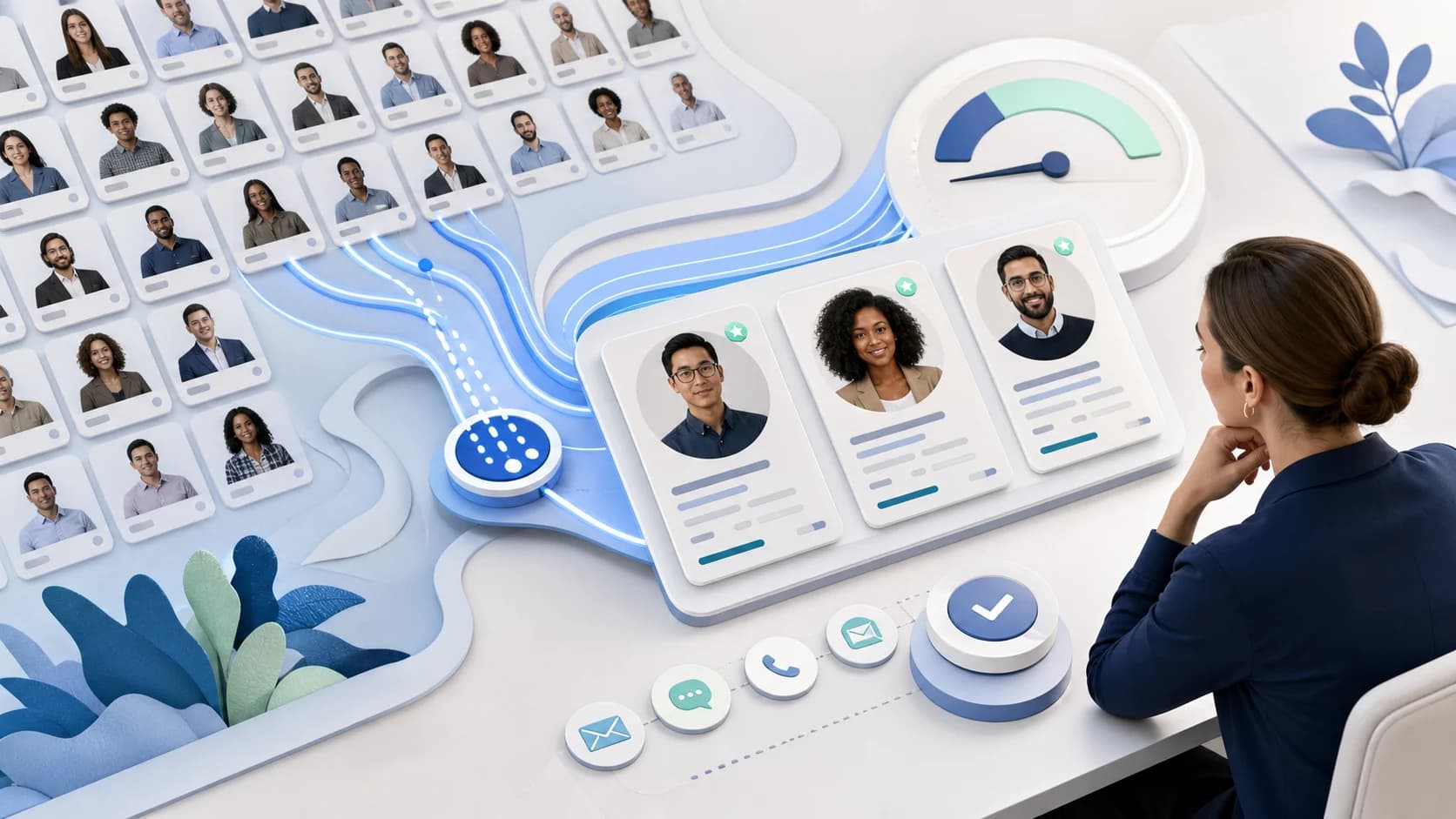
The alternative to task-tool adoption is agent-pipeline thinking. The core principle is to define the hiring pipeline as a series of accountable stages, then assign an autonomous agent to each stage, with automatic handoff logic between stages based on defined candidate criteria.
This is not about removing humans from hiring. It is about relocating human judgment to where it actually matters. In a well-designed agent pipeline, each stage runs independently:
Sourcing
→
Calling
→
Screening
→
Interviewer
→
Scheduling
→
Offer
- Sourcing agent: Identifies qualified candidates across job boards, LinkedIn, and professional networks, without a recruiter building search queries.
- Calling agent: Conducts AI-powered telephonic outreach to engage and qualify candidates, filtering for availability and interest before any human reviews the list.
- Screening agent: Filters and scores candidates against job criteria, so hiring managers receive a pre-qualified shortlist, not a stack of applications.
- Interviewer agent: Conducts async, skill-based video interviews at candidate-chosen times, assessing real competencies against role requirements.
- Scheduling agent: Books confirmed candidates with hiring managers automatically, eliminating the 5.1-day average scheduling window down to 1.4 days.
- Offer agent: Manages offer generation, tracking, and candidate communication through to acceptance, without HR operations as a manual bottleneck.
The human role becomes review and approval at defined checkpoints, not coordination between every step. This directly addresses the 35% of recruiter time lost to scheduling, the 22% of TA teams that cannot effectively manage human-AI handoffs, and the 182% increase in application volume without a proportional increase in recruiter capacity.
“AI and cost pressures are the two primary forces driving the top four talent acquisition trends in 2026.”
Gartner, October 2025
How to Transition from AI Tools to AI Hiring Agents
Start by auditing your current pipeline for coordination cost, not task speed. The goal is to find the gaps between steps, not just measure how fast individual steps run.
- Map every pipeline stage (1-2 days): List each step from job creation to offer acceptance. Identify who or what triggers the transition between stages. Human triggers are your automation targets.
- Find your highest-volume bottleneck (1 day): GoodTime data shows scheduling alone consumes 35% of recruiter time. That is typically the first stage to automate with measurable ROI.
- Select an agent for your highest-volume stage (1-2 weeks evaluation): Don’t start with sourcing. Start where volume is highest and required human judgment is lowest. For most teams, that is screening or scheduling. When sourcing’s turn does come, our guide to passive sourcing with AI agents covers the operating discipline it needs.
- Design handoff criteria before you deploy (1 week): Define exactly which conditions trigger an automatic handoff to the next stage. Ambiguous handoffs reintroduce the coordination costs you are trying to eliminate.
- Measure pipeline throughput, not tool metrics (ongoing): Track end-to-end time-to-hire and offer-acceptance rate, not just the efficiency of the individual agent stage. The goal is pipeline speed, not stage speed.

Expect measurable improvement in time-to-shortlist within 30 days of deploying an agent at your bottleneck stage. Full-pipeline ROI, including lower cost-per-hire and faster time-to-offer, typically materializes across the first full quarterly hiring cycle.
Caveats: What Agent Automation Gets Wrong When Deployed Carelessly
The agent-pipeline model has real limitations. Candidate trust in AI evaluation remains low: only 26% of job seekers trust AI to evaluate them fairly (Korn Ferry, 2026), and 67% are comfortable with AI screening only if a human makes the final hiring decision (Glassdoor, 2024). This is not a reason to avoid agent automation. It is a reason to design human checkpoint architecture thoughtfully and communicate it transparently to candidates.
Compliance is non-trivial for global operations. The EU AI Act classifies AI systems used in hiring as high-risk under its regulatory framework. California finalized AI employment regulations in October 2025 requiring meaningful human oversight of automated hiring decisions. Organizations operating across multiple geographies need compliance-aware AI hiring agent platforms, not just fast ones.
And the bias risk is real. If your job criteria or screening rubrics carry embedded bias, an autonomous agent will reproduce that bias at scale and at speed. The technology amplifies whatever quality of criteria you put in. Agent adoption without criteria auditing is not an upgrade; it is an acceleration of existing problems. We cover the specific bias-mitigation controls built into AI hiring agents in a separate guide.
Frequently Asked Questions
Will autonomous AI hiring agents eliminate recruiting jobs?
The data doesn’t support mass elimination, but it does support role transformation. Korn Ferry found 43% of companies plan to replace roles with AI, with back-office operations (58%) and entry-level positions (37%) as the primary targets. Most TA leaders expect recruiting roles to shift toward relationship management, hiring manager advisory, and strategic planning rather than disappear. The demand for human judgment in complex, senior, or culturally critical hiring decisions is growing, not shrinking. What is being automated is the process coordination, not the judgment.
We have already invested in point-solution AI tools for recruiting. Do we need to start over?
Point solutions and agent pipelines are not mutually exclusive. You don’t need to replace your ATS or existing AI screener. Start by auditing where coordination gaps exist between your current tools. If your AI screener hands off to a human scheduler before an AI scheduling tool picks up, that human-in-the-middle step is where coordination cost lives. An agent layer can often sit on top of existing tools to automate that handoff logic without rebuilding your stack from scratch. The transition is incremental, not a rip-and-replace.
How does this apply to staffing firms differently than in-house TA teams?
Staffing firms face the highest version of the volume problem: managing hundreds of open roles across multiple clients simultaneously. The ROI case for agent pipelines is actually stronger for staffing than for in-house TA, because coordination cost compounds across entire client portfolios. The Sourcing and Calling stages are particularly high-impact for staffing: the ability to run AI-powered candidate outreach across multiple roles simultaneously, without proportional recruiter headcount, is the primary competitive differentiator in 2026 for high-volume placement firms.
How Intervuebox.ai Addresses the AI Coordination Gap in Hiring Pipelines
The problem this article surfaces (task-tool AI failing to reduce time-to-hire because human-gated handoffs reintroduce the coordination costs that individual automations remove) is precisely the architecture problem Intervuebox.ai was built to solve.
Rather than layering AI onto existing recruiter workflows, Intervuebox deploys six purpose-built agents across the complete hiring pipeline. The Sourcing and Calling agents handle candidate identification and AI-powered telephonic qualification before any recruiter reviews the list, eliminating early-stage volume pressure entirely. The Screening and Interviewer agents assess candidates through async, role-specific video interviews, delivering pre-qualified shortlists to hiring managers, not just pre-sorted stacks. The Scheduling and Offer agents close the loop automatically, removing HR operations as a bottleneck at every downstream step.
For global or multi-geography teams, the platform is ISO 27001, GDPR, SOC Type 2, and UAE PDPL compliant, meeting the regulatory obligations outlined above without requiring custom compliance engineering. Whitelabel and multilingual deployment mean the pipeline runs under your brand, in your candidates’ language.
Book a 30-min demo with our founders →
The Industry Shift That Is Already Happening
The “AI helps recruiters” model had its moment. In 2026, the breakout is autonomous AI agents running entire pipeline stages with minimal human coordination between them. The 52% of talent leaders planning agent adoption are not running a technology experiment. They are responding to a talent supply-demand equation that no longer works with human-gated pipelines processing 182% more applications than they did three years ago.
The teams that hire better in 2026 will stop asking “how can AI help my recruiters?” and start asking “which pipeline stages can run autonomously, with humans reviewing outcomes rather than managing every handoff?”
That shift in framing is where the real competitive advantage in talent acquisition lives right now. The organizations making it are already pulling ahead, and the Korn Ferry data shows that 52% have already committed to making it in 2026.
Intervuebox.ai Editorial
Full-stack AI hiring platform covering the complete pipeline from sourcing to offer. ISO 27001, GDPR, SOC Type 2, and UAE PDPL certified. Serving staffing firms, mid-size companies, and global enterprises from Ahmedabad, India.
Written by Arpit Bhardwaj
Co-founder & CEO of IntervueBox, writing about AI-driven hiring, interviews and recruitment automation.
See it in action
Put the ideas from this article to work with IntervueBox:
Stay up to date
Recruitment strategy tips, guides and live Q&As, straight to your inbox.