
AI Telephonic Interview 2026: 5 Proven Reasons Voice Screens Are Replacing Recruiter Phone Calls
AI telephonic interview is reshaping hiring. 80% of TA teams are switching to voice AI. 5 proven reasons with real data.
Table of Contents
- What’s Driving the AI Telephonic Interview Revolution in 2026?
- Why Traditional Recruiter Phone Screens Can’t Keep Up
- How AI Telephonic Interviews Work. And What Makes Them Different
- Which Organizations Are Adopting AI Voice Screens Fastest
- What Candidates Actually Think About AI Phone Screens
- 5 Steps TA Leaders Should Take Before Mid-2026
- How Intervuebox.ai Addresses the Problem of Slow, Costly Phone Screens
- Frequently Asked Questions
- Conclusion
The AI telephonic interview is no longer a futuristic concept, it’s the new standard for first-contact candidate screening in 2026. AI adoption in HR tasks climbed to 43% in 2025, up sharply from 26% just a year earlier (SHRM Talent Trends, 2025). At the same time, the traditional recruiter phone screen, once the cornerstone of candidate qualification, is struggling under the weight of high-volume hiring demands, scheduling chaos, and a talent market that never sleeps.
What changed? AI voice agents can now conduct structured, multilingual telephonic screening calls 24 hours a day, at a fraction of the cost of a human recruiter’s time. A staffing team that once managed eight to ten phone screens per recruiter per day can now process hundreds, without adding headcount. The phone screen isn’t disappearing. It’s just no longer being answered by a human.
This article breaks down exactly why the AI telephonic interview has moved from experiment to standard practice, who is adopting it, what candidates think, and what talent acquisition leaders need to do right now to stay ahead.
Key Takeaways
- AI adoption in HR hit 43% in 2025, up from 26% in 2024, and the sharpest gains are in recruiting (SHRM, 2025).
- AI phone screens achieve 70%+ completion rates vs. a 42% dropout rate for video interviews (HR technology industry analysis, 2026).
- Candidates screened by AI have a 53% pass rate in subsequent human interviews, compared to 29% for traditional resume-only methods (AI recruiting technology field data, 2025).
- The AI-powered recruiter interview market is projected to grow from $1.7B in 2025 to $2.22B in 2026, on track for $6.4B by 2030 (Business Research Company, 2026).
What’s Driving the AI Telephonic Interview Revolution in 2026?
AI telephonic interview adoption in 2026 is being pulled forward by two converging forces: runaway hiring volumes and a market that simply priced out manual phone screens. According to SHRM’s 2025 Talent Trends report, 89% of HR professionals now say AI saves them time or increases efficiency, and the single fastest-growing application is candidate qualification. AI isn’t just a nice-to-have; for high-volume recruiters, it’s become the only way to keep up.
The market numbers reflect the urgency. The AI-powered recruiter interview assistant market was valued at $1.7 billion in 2025 and is projected to reach $2.22 billion by the end of 2026: a CAGR of 30.6%, climbing to $6.4 billion by 2030 (Business Research Company / Research and Markets). That’s not the growth curve of an emerging niche. That’s an industry-wide replacement cycle.
AI Recruiter Interview Market Size ($B) $7B $5B $3B $2B $1B $1.7B $2.22B $6.4B 2025 2026 2027 2028 2029 2030 CAGR: 30.6%
Source: Business Research Company / Research and Markets, 2026
Three factors are colliding to accelerate adoption. First, the volume problem: a mid-size company receiving 300 applications for a single role cannot afford to have a recruiter spend 15 minutes on each first call. Second, the scheduling problem: top candidates accept the fastest offer, and a 3-day wait for a recruiter’s availability is now a disqualifying delay. Third, the quality problem: unstructured human phone screens introduce inconsistency and compliance risk at scale. AI telephonic interviews solve all three at once.
McKinsey’s November 2025 State of AI report found that 78% of organizations now use AI in at least one business function, with 88% of surveyed leaders reporting regular AI use (McKinsey, 2025). Talent acquisition is no longer a laggard in AI adoption, it’s at the center of the rollout.
Why Traditional Recruiter Phone Screens Can’t Keep Up
The traditional recruiter phone screen was designed for a world where hiring volumes were manageable and candidates patiently waited their turn. That world is gone. A skilled recruiter running back-to-back calls handles roughly eight to ten meaningful screens per day, while an AI voice agent can conduct more than 200 structured screening calls in the same window, every day, including weekends. The math isn’t close anymore.

The cost equation is equally stark. A human recruiter’s fully loaded cost, salary, benefits, overhead, means each manual phone screen can run $25–$50 in direct labor alone, before accounting for scheduling back-and-forth and no-show rates. For a staffing firm processing 5,000 first-stage screens per month, that’s a six-figure monthly cost that AI can reduce by 60-80%.
Scheduling alone is a silent killer. The average candidate requires 2.3 touchpoints before a phone screen is confirmed, and no-show rates on manually scheduled recruiter calls often exceed 30% in hourly and shift-based roles. AI telephonic interviews let candidates self-schedule, or complete the screen immediately when called by the AI, removing the scheduling bottleneck entirely.
There’s also a consistency problem that traditional phone screens have never solved. Different recruiters ask different questions, evaluate tone differently, and carry unconscious bias into every call. The result is a first-stage assessment that’s more influenced by a recruiter’s mood on a Tuesday afternoon than by the candidate’s actual qualifications. Structured AI telephonic interviews ask every candidate the same questions, score responses against the same rubric, and produce a comparable output that hiring managers can actually use.
How AI Telephonic Interviews Work: And What Makes Them Different
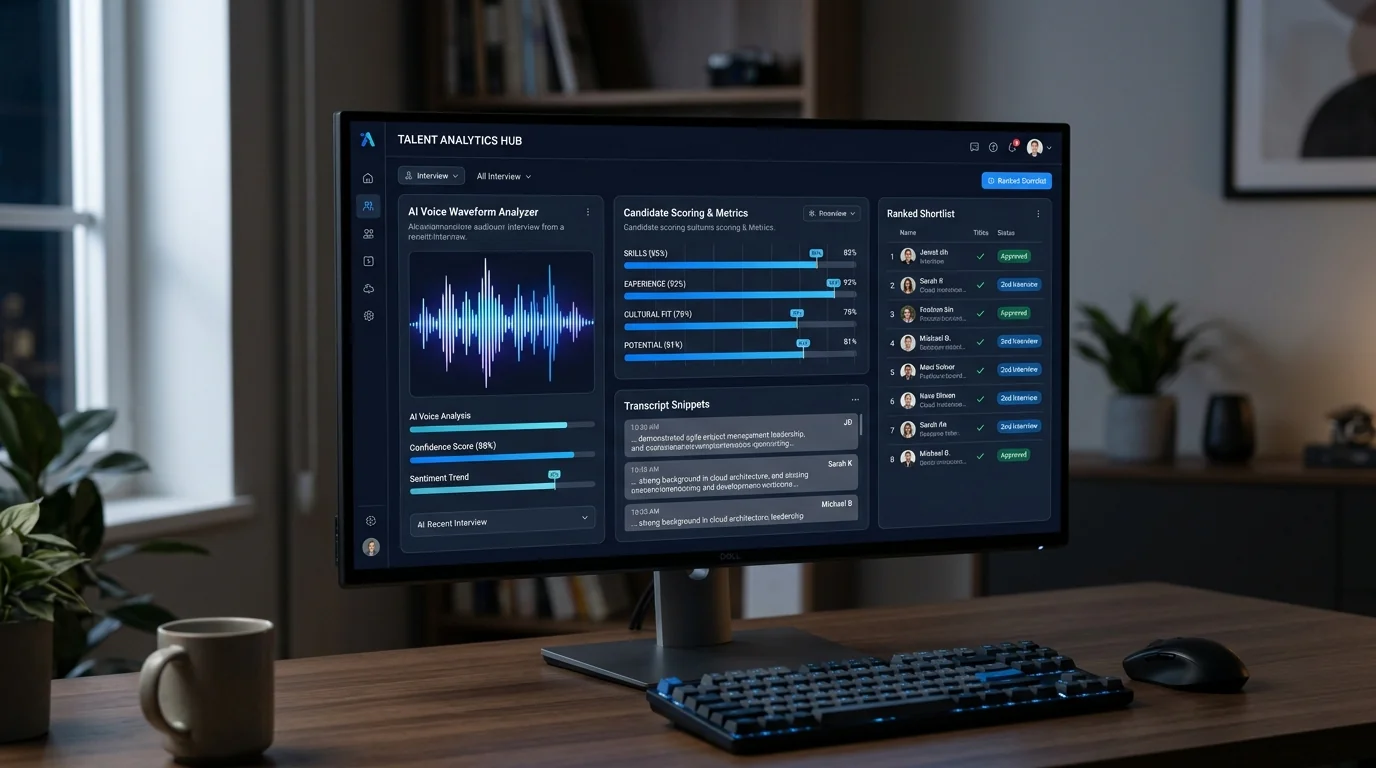
AI telephonic interviews in 2026 are built on conversational AI models that can hold a natural, branching phone conversation, not just play a pre-recorded script. The AI calls the candidate (or receives their inbound call), introduces itself as an AI interviewer, and works through a structured set of role-specific screening questions. Responses are transcribed, scored for relevance and clarity, and delivered to the recruiter as a ranked assessment report within minutes of the call ending.
AI vs Traditional Screening Outcomes Interview Completion Rate Pass-Through to Human Interview (AI Screened) Pass-Through (Traditional Resume Method) 70% AI Phone Screen 58% Video Interview 53% 29% AI-Powered Traditional / Video
Sources: HR technology industry analysis, 2026; AI recruiting technology field data, 2025
What makes AI telephonic interviews meaningfully different from earlier robocall-style screeners is the conversational quality. Modern systems can detect when a candidate gives a short answer and follow up with a probe. They can handle natural pauses, cross-language code-switching, and non-native accents without breaking the conversation. For global staffing firms running multilingual screens across markets in the UAE, UK, and India simultaneously, this isn’t a feature, it’s a prerequisite.
Completion rates tell the story clearly. AI phone screens achieve 70%+ completion rates, compared to a 42% dropout rate for video interviews, a format many candidates find intimidating or technically demanding (HR technology industry analysis, 2026). Voice is familiar. You don’t need a quiet room, a clean background, or a working camera. You just need your phone.
The output is also standardized in a way that recruiter-led calls never are. Every AI telephonic interview produces a transcript, a structured score against the job criteria, and a recommended next step, all timestamped and auditable. For enterprises with compliance obligations under GDPR, ISO 27001, or emerging AI hiring regulations, that audit trail is increasingly non-negotiable.
Which Organizations Are Adopting AI Voice Screens Fastest
AI telephonic interview adoption is fastest where the volume pressure is highest. Staffing firms and high-volume employers, logistics, retail, healthcare, BPO, are the earliest movers. Companies that automated recruiting workflows filled 64% more jobs and submitted 33% more candidates per recruiter compared to non-adopters, according to data from the LinkedIn Future of Recruiting, 2025 report. For staffing firms paid on placement speed, that productivity delta is an existential competitive advantage.

Large enterprises are the second wave. LinkedIn’s Future of Recruiting 2025 report found that TA teams using AI save approximately 20% of their work week: roughly one full workday, while being 9% more likely to make quality hires. For an enterprise with a 50-person TA function, that’s the equivalent of gaining 10 additional recruiters without increasing headcount.
Mid-size companies (100–2,000 employees) are the third and fastest-growing adopter segment. These organizations lack the budget for large TA teams but face the same hiring complexity as enterprises. AI telephonic interviews let them punch above their weight, screening 300 applicants for a specialized role without pulling their HR director into back-to-back calls for two weeks.
AI Adoption in HR Functions (%) 2024 26% 2025 43% 2026 ~58%* *2026 figure projected based on SHRM YoY trend Source: SHRM Talent Trends, 2025
Source: SHRM Talent Trends 2025; 2026 figure is extrapolated projection
What Candidates Actually Think About AI Phone Screens
Candidate receptivity to AI telephonic interviews is higher than most HR leaders expect, provided transparency is part of the design. According to SHRM’s 2025 Talent Trends research and supporting industry surveys, 67% of candidates are comfortable with AI handling initial screening as long as a human makes the final hiring decision. A further 79% of job seekers want to know when AI is involved in their assessment.

The message from candidates is consistent: they’re fine with AI screening. What they’re not fine with is being surprised by it. Organizations that disclose upfront. “Your first interview will be conducted by our AI”, report neutral to positive candidate feedback at rates comparable to human phone screens. Those that don’t disclose create reputational risk that undoes the operational benefit.
There’s also a genuine access benefit. AI telephonic interviews are available outside business hours, which matters enormously for candidates in shift-based jobs who can’t take a private call at 2pm on a Wednesday. The 24/7 availability isn’t just an operational convenience, it’s a meaningful expansion of who can realistically apply.
The quality signal from AI-screened candidates is also stronger. Candidates who complete an AI telephonic screen and advance have a 53% pass rate in subsequent human interviews, compared to just 29% for candidates who progressed through traditional resume-only review (AI recruiting technology field data, 2025). The AI is a better filter, not because it’s smarter than a recruiter, but because it’s consistent.
5 Steps TA Leaders Should Take Before Mid-2026
AI telephonic interviews aren’t a “someday” decision anymore, they’re a right-now infrastructure question. TA leaders at staffing firms and mid-to-large enterprises who wait until Q3 2026 to evaluate AI voice screening will be operating at a structural disadvantage against competitors who are already processing 10x the interview volume at a fraction of the cost. Here’s where to start.
- Audit your current phone screen bottleneck. Map exactly how many first-stage screens your team runs per week, what the recruiter time cost is, and where no-shows and scheduling delays are occurring. This is your baseline for ROI calculations, and it’s usually more alarming than expected.
- Define your structured question sets per role family. AI telephonic interviews work best when the screening questions are role-specific and scored. Generic “tell me about yourself” openers produce weak signal. Role-calibrated questions, three to five per position, produce the quality data hiring managers need to make confident decisions.
- Ensure compliance readiness before launch. Regulations governing AI in hiring are tightening globally, from the EU AI Act’s high-risk classification to emerging US state-level requirements. Organizations operating in multiple jurisdictions need to confirm that their AI telephonic interview vendor is auditable, bias-tested, and fully documented. For multi-country teams, certifications like ISO 27001, SOC 2, and GDPR compliance are minimum requirements.
- Design a transparent candidate disclosure process. Inform candidates before the call begins that they’re speaking with an AI system. Include the disclosure in the job application confirmation, in the calendar invite, and in the call’s opening statement. Transparency isn’t just a legal consideration, it’s a direct driver of completion rates and employer brand.
- Integrate your AI telephonic interview data with your ATS. AI voice screens that produce scores in a silo are only marginally better than no screen at all. The value compounds when structured assessment data flows automatically into your applicant tracking system and surfaces in the recruiter’s queue ranked by fit. Without integration, you’ve automated a task but not a workflow.
How Intervuebox.ai Addresses the Problem of Slow, Costly Phone Screens
The core problems this article covers, screening bottlenecks at scale, inconsistent qualification data, scheduling friction, and multilingual hiring complexity, are exactly what Intervuebox.ai’s Calling Agent is built to solve.
Intervuebox’s Calling Agent conducts structured AI telephonic interviews autonomously, operating 24/7 across languages and time zones. Unlike point solutions that handle only the voice screen in isolation, the Calling Agent sits within a fully sequenced hiring pipeline: Sourcing → Calling → Screening → Interviewer → Scheduling → Offer. The structured output from each telephonic call flows directly into the Screening Agent’s scoring workflow, so recruiters receive a ranked, comparable shortlist, not a stack of call notes to interpret.
For high-volume use cases, the platform’s multilingual capability removes a barrier that traditionally forced global organizations into fragmented, market-by-market hiring processes. The whitelabel option lets staffing firms deploy the Calling Agent under their own brand, maintaining client relationships without hiring additional staff.
For instance, a staffing firm using Intervuebox’s Calling Agent can run 500 first-stage telephonic screens over a weekend, across English, Arabic, and Hindi, and deliver a ranked shortlist to their client by Monday morning, complete with transcripts and structured scores against the job criteria.
The platform is ISO 27001, SOC Type 2, GDPR, and UAE PDPL compliant, meeting the compliance requirements that enterprise and regulated-industry clients require before deployment. See how Intervuebox fits your hiring pipeline at intervuebox.ai.
Frequently Asked Questions
What is an AI telephonic interview and how does it differ from a traditional phone screen?
An AI telephonic interview is a structured phone screening call conducted by an AI voice agent instead of a human recruiter. The AI asks role-specific questions, listens and transcribes responses in real time, and scores candidates against a predefined rubric. Unlike human screens, AI telephonic interviews run 24/7, score consistently, and produce an auditable output record. Completion rates for AI phone screens reach 70%+, compared to a 42% video interview dropout rate (HR technology industry analysis, 2026).
Are candidates comfortable being interviewed by an AI on the phone?
Yes, when organizations are transparent. Research finds that 67% of candidates are comfortable with AI handling initial screening as long as a human makes the final decision, and 79% want disclosure that AI is involved in their assessment (SHRM Talent Trends, 2025). Disclosure before the call begins is the single most important factor in candidate acceptance and completion rates.
How accurate is AI telephonic screening compared to human phone screens?
Candidates screened by AI advance to human interviews at a 53% rate, compared to just 29% for candidates who move through traditional resume-only review (AI recruiting technology field data, 2025). The improvement is driven by consistency. AI applies the same structured criteria to every candidate, eliminating the interviewer-to-interviewer variability that degrades signal quality in manual phone screen programs.
What compliance and legal considerations apply to AI telephonic interviews in 2026?
AI telephonic interviews are classified as high-risk AI systems under the EU AI Act, requiring bias audits, transparency disclosures, and human oversight at decision points. In the United States, New York City’s Local Law 144 requires bias audits for automated employment decision tools. Globally, GDPR and emerging market regulations like UAE PDPL govern data handling and consent. Organizations should require vendors to demonstrate ISO 27001 and SOC 2 certifications and maintain full call transcripts as audit documentation.
How much does implementing AI telephonic interviews save in recruiting costs?
Cost savings depend on volume and recruiter cost structure, but the productivity impact is significant: companies using recruiting automation fill 64% more jobs and submit 33% more candidates per recruiter versus non-adopters (LinkedIn Future of Recruiting, 2025). For high-volume hiring teams, eliminating scheduling overhead and reducing no-show rates alone can recover dozens of recruiter hours per week.
Conclusion: The Phone Screen Isn’t Dead: The Human Doing It Is Optional
The AI telephonic interview isn’t a technology you need to evaluate someday. It’s infrastructure that high-performing recruiting teams are deploying right now, and the productivity and quality data show why. With AI adoption in HR passing 43% and climbing, the window for being an early mover rather than a laggard is closing faster than most TA leaders realize.
The organizations that will win the talent market in 2026 and beyond aren’t the ones with the most recruiters, they’re the ones with the best-calibrated AI voice screens, the cleanest ATS integrations, and the fastest time-to-shortlist. If your phone screen process still depends on a human picking up the call, that’s where to start.
Key takeaways:
- AI adoption in HR hit 43% in 2025 and is accelerating. AI telephonic interviews are the fastest-growing application in recruiting.
- AI phone screens complete at 70%+ vs. 42% dropout for video, candidates prefer the phone format, especially in shift-based roles.
- AI-screened candidates pass subsequent human interviews at 53% vs. 29% for resume-only filtering, the quality signal is measurably better.
- Compliance readiness (ISO 27001, SOC 2, GDPR) and ATS integration are the two non-negotiables before deployment.
- Disclosure and transparency are the foundation of candidate trust, and directly drive completion rates.
Ready to see how AI telephonic screening fits your hiring pipeline? Book a 30-minute demo with the Intervuebox founders and walk through how the Calling Agent handles your specific volume and compliance requirements.
Written by Arpit Bhardwaj
Co-founder & CEO of IntervueBox, writing about AI-driven hiring, interviews and recruitment automation.
See it in action
Put the ideas from this article to work with IntervueBox:
Stay up to date
Recruitment strategy tips, guides and live Q&As, straight to your inbox.