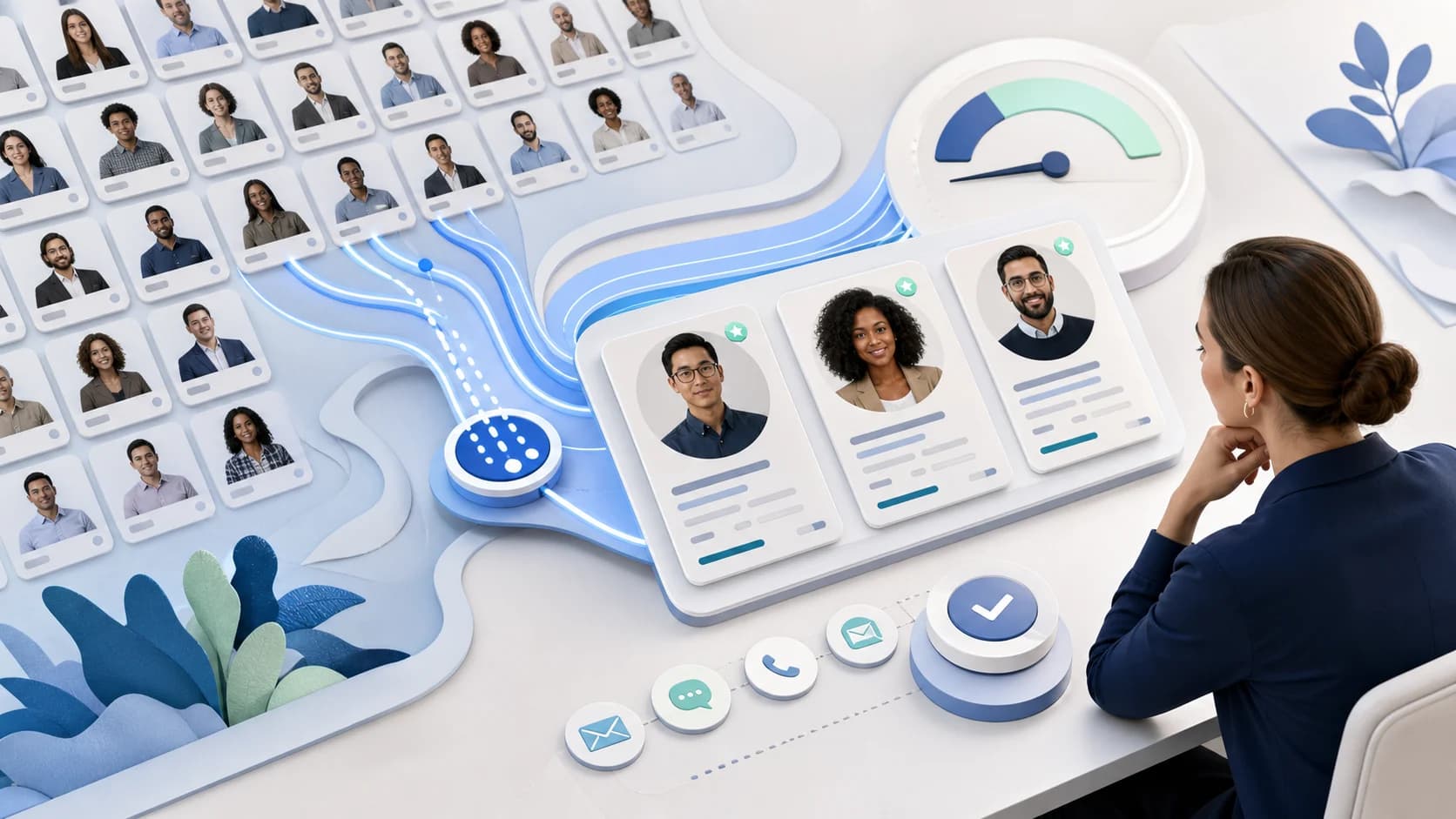

Staffing Firm AI Hiring Pipeline: The Proven Gap Costing Talent Teams in 2026
Staffing firm AI hiring jumped 65% but time-to-hire is rising. Discover the pipeline gap costing talent teams and how to fix it.


Key Takeaways
- AI use for HR tasks jumped 65% year-over-year to 43% of organizations in 2025, yet average time-to-hire has climbed from 33 days in 2021 to 41 days in 2024 (SHRM 2025).
- The root cause is not AI itself but pipeline fragmentation: the average organization now runs 26 disconnected HR technology modules, up from 10 in 2020.
- 42% of candidates drop out specifically because scheduling interviews took too long, according to a 12,000-candidate Cronofy survey.
- Each unfilled position costs companies an average of $4,129 in lost productivity over the hiring cycle, according to SHRM data, making pipeline fragmentation a direct P&L issue.
- High-performing staffing firms are replacing point-solution sprawl with end-to-end recruiting operating systems that keep candidates moving through every stage without manual handoffs.
- Only 39% of organizations rate their current talent acquisition tech stack as good or excellent, signaling a wide gap between investment and outcome (HR.com 2025).
Table of Contents
- AI Adoption in Staffing Is Accelerating. So Why Are Hire Targets Still Slipping?
- The Anatomy of a Broken Staffing Firm AI Hiring Pipeline
- Where Candidates Are Falling Through the Cracks
- The Hidden Cost of Pipeline Fragmentation
- The Integration Imperative: What High-Performing Staffing Firms Are Doing Differently
- How Intervuebox.ai Addresses Pipeline Fragmentation
- The Paradox Has a Solution
- Frequently Asked Questions
Staffing firm AI hiring has a hidden gap that’s costing talent teams placements, even as AI adoption surges. Here’s what’s going wrong.
The staffing firm AI hiring pipeline has never been better funded, yet outcomes have rarely been worse. AI use for HR tasks climbed to 43% of organizations in 2025, up from 26% the year prior: a 65% year-over-year jump (SHRM 2025 Talent Trends). At the same time, average time-to-hire keeps rising. More tools, more investment, and more optimism, yet the hires are not coming faster. Something is structurally broken, and it is costing talent teams more than they realize.
AI Adoption in Staffing Is Accelerating: So Why Are Hire Targets Still Slipping?
The staffing firm AI hiring pipeline is expanding faster than most HR leaders anticipated. 64% of organizations using AI for HR apply it specifically to recruiting, interviewing, or hiring: the single most common use case across the entire HR function (SHRM 2024 Talent Trends). The investment signal is unmistakably bullish.
The results, however, are moving in the opposite direction. Cost-per-hire and time-to-hire both increased over the past three years: the exact same period that saw AI adoption surge (SHRM). Average time-to-hire has climbed 24% since 2021, from 33 days to 41 days. Average time-to-fill sits at approximately 44 days in the U.S. These are not rounding errors. They represent a genuine paradox at the heart of every staffing firm AI hiring pipeline that is built from disconnected point solutions.
Average Time-to-Hire (Days) 2021–2025 33 2021 36 2022 38 2023 41 2024 44 2025 Source: SHRM 2025 Recruiting Benchmarking Report
What explains this paradox? 89% of HR professionals in AI-using organizations say AI saves time or increases efficiency (SHRM State of AI in HR 2026). They are not wrong. The problem is that local efficiency in one stage, faster resume screening, for example, does not translate to pipeline efficiency when the next stage runs on a disconnected tool. Speed earned in one node is lost in the handoff.
The recruiter workload data tells this story numerically. Recruiters now manage 56% more open requisitions (14 reqs) and 2.7 times more applications (2,500+) than three years ago: without a proportional improvement in fills. Hires per recruiter declined from roughly 7 per quarter in early 2021 to 5.4 per quarter in 2024 (CareerPlug 2025, 10M+ applications analyzed). More AI, more applications, fewer hires per recruiter. The math does not add up, until you map the staffing firm AI hiring pipeline stage by stage.

Citation Capsule: AI use for HR tasks climbed from 26% to 43% of organizations between 2024 and 2025, a 65% year-over-year increase, yet average time-to-hire has risen 24% over the same four-year period, from 33 days in 2021 to 41 days in 2024. Both metrics come from SHRM’s 2025 Talent Trends and Recruiting Benchmarking reports, pointing to a structural gap between tool adoption and pipeline outcomes in the staffing firm AI hiring pipeline.
The Anatomy of a Broken Staffing Firm AI Hiring Pipeline
A broken staffing firm AI hiring pipeline is rarely the result of bad technology choices. It is the predictable outcome of layering multiple best-in-class point solutions on top of one another without a unifying data architecture. Organizations now run an average of 26 HR technology modules: more than double the 10-module average in 2020 (Sapient Insights Group 2024-2025 HR Systems Survey). Each module may work well in isolation. Together, they create friction at every handoff.
The fragmentation problem surfaces most clearly at the integration layer. 56% of HR buyers say improving integrations is their top purchase driver in 2025, above adding new AI capabilities (54%) (Gartner Digital Markets 2025). That ranking is telling. Talent leaders are not asking for more AI. They are asking for the AI they already have to talk to each other. The priority has shifted from acquisition to connection, a shift the staffing firm AI hiring pipeline market has been slow to respond to.
The redundancy data compounds the problem. 50% of HR software systems perform overlapping functions, according to a Capterra survey cited by SHRM (SHRM). The result is constant context-switching between redundant systems, a direct drag on the recruiter time that AI was supposed to free up. The tools themselves become the problem.
54% of organizations use 2-5 paid talent acquisition tools, and only 25% rely on a single tool (HR.com 2025). Large enterprises commonly run more than 80 different employee-facing systems. These are not outlier firms with procurement problems. This is the industry norm. And it explains why only 39% of organizations rate their TA technology stack as good or excellent: despite record levels of spending on it.
Every disconnected tool in the staffing firm AI hiring pipeline introduces a manual handoff point. A sourcing platform that identifies a strong candidate passes a CSV to the ATS. The ATS triggers a scheduling email. The scheduling email links to a third-party calendar tool. The calendar confirmation feeds back to a video interview platform. None of these systems share candidate context natively. Each transition is a moment when the process slows, a recruiter intervenes manually, and the candidate waits.
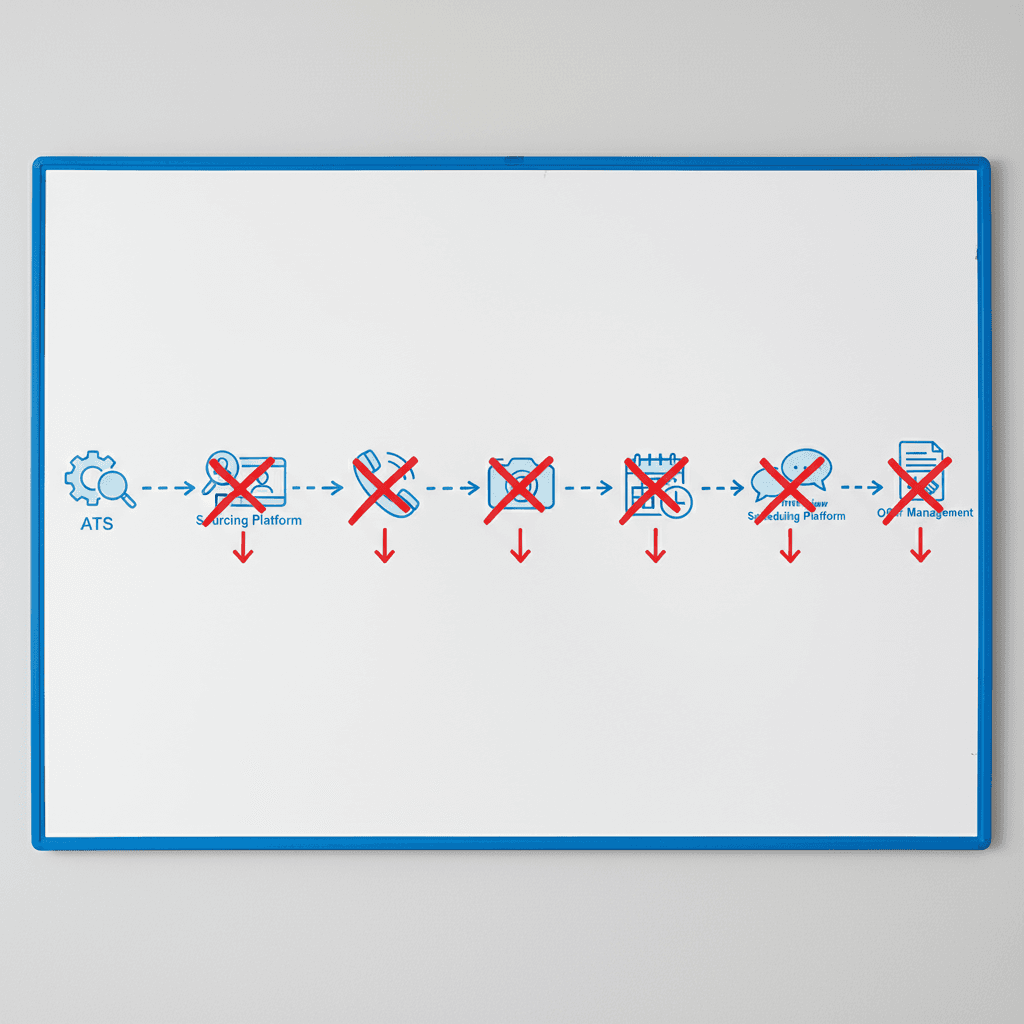
Citation Capsule: The average organization runs 26 HR technology modules today, up from 10 in 2020, yet 50% of HR software systems perform overlapping functions and employees use only two-thirds of their stack regularly. This structural redundancy is the primary driver of staffing firm AI hiring pipeline fragmentation in 2025-2026. (Sapient Insights Group 2024-2025 HR Systems Survey; SHRM/Capterra)
Where Candidates Are Falling Through the Cracks
Pipeline fragmentation in the staffing firm AI hiring pipeline does not just slow the process, it actively drives candidates away. 42% of candidates dropped out specifically because scheduling interviews took too long, according to a survey of 12,000 candidates by Cronofy (Cronofy Candidate Expectations Report 2024). That is not a candidate engagement problem. It is a tooling problem: when scheduling lives in a separate system from the interview platform, delays compound until the candidate accepts another offer.
Where Candidates Drop Off in the Hiring Funnel Post-interview ghosting 61% Application abandonment 60% Scheduling friction 42% Interview stage drop-off 32% Overall hire rate (click-to-hire) 0.6% 0% 75% Sources: Cronofy 2024 · CareerPlug 2025 · Josh Bersin Company 2025 · The Interview Guys 2025
The funnel numbers from CareerPlug’s 2025 analysis of more than 10 million applications reveal how steep the attrition really is across a typical staffing firm AI hiring pipeline. Only 6% of people who click a job ad complete an application. Of those applicants, 8% reach a screening call. 37% of screened candidates get an interview. The compounding effect produces an overall hire rate of just 0.6%: six hires per thousand job-ad clicks. Every friction point in a fragmented pipeline makes each of those conversion rates worse.
The scheduling stage is particularly underestimated as a drop-off driver. The interview stage accounts for 32% of all candidate drop-off, and the scheduling stage adds another 20% (Pin.com 2025). Together, these two adjacent stages account for more than half of all candidate exits in the staffing firm AI hiring pipeline. Most AI investment targets sourcing and screening, the stages before scheduling. The attrition evidence points downstream.
Ghosting compounds the drop-off problem. 61% of candidates experience post-interview ghosting, up 9 percentage points since early 2024 (The Interview Guys 2025 Ghosting Index). When the ATS, scheduling tool, and communication platform are not synchronized, follow-up falls through the cracks. 48% of candidates are less likely to recommend an employer following poor scheduling experiences (Cronofy 2024). The pipeline problem becomes a brand problem.
The candidate window is brutally short. Candidates typically leave the market within 10 days (SHRM 2025 Benchmarking). With an average time-to-fill of 44 days, most staffing firm AI hiring pipelines are structured around a timeline that is four times longer than the window in which the best candidates remain available. Speed at the top of the funnel without speed through the funnel does not solve this mismatch.
The Hidden Cost of Pipeline Fragmentation
Pipeline fragmentation has a dollar figure that most talent leaders never see as a single line item. SHRM data shows that each open position costs companies an average of $4,129 in lost productivity over a typical 42-day vacancy period (Hoops HR 2024), before factoring in recruiter hours, sourcing costs, or the compounding cost of filling the same role twice. The U.S. Department of Labor estimates that a bad hire costs at least 30% of the employee’s first-year earnings (SHRM). For a $70,000 role, that is $21,000 gone.
Talent leaders often experience these costs as separate budget line items, recruiter overtime, agency fees, a bad hire buried in a Q3 write-down. The connection to pipeline structure rarely surfaces in retrospective analysis. But the numbers converge on the same conclusion: a fragmented staffing firm AI hiring pipeline that extends time-to-fill by even five days costs more than most premium integration solutions charge in annual fees.
The recruiter productivity data reinforces this calculus. Hires per recruiter declined from roughly 7 per quarter in early 2021 to 5.4 per quarter in 2024 (CareerPlug 2025). That is a 23% drop in output per recruiter during a period when AI investment was rising. Part of the explanation is volume: 2.7 times more applications with no proportional improvement in fills. But the other part is tooling friction: recruiters spend time switching between systems rather than advancing candidates through the staffing firm AI hiring pipeline.
76% of employers globally still report difficulty filling roles, despite rising AI use (ManpowerGroup 2026 Global Talent Shortage Report). 69% of companies still report difficulty filling roles despite AI tools being more widely used (SHRM 2025 Talent Trends). The talent shortage is real. But a broken pipeline ensures that even available talent slips away before a hiring decision is made.

Citation Capsule: SHRM data shows each open position generates an average of $4,129 in direct productivity loss over a 42-day vacancy period (Hoops HR 2024), before agency fees or bad-hire costs. A bad hire then adds at least 30% of first-year salary on top (U.S. Department of Labor, via SHRM). The cost of a broken staffing firm AI hiring pipeline is not theoretical; it appears in every quarterly headcount report.
The Integration Imperative: What High-Performing Staffing Firms Are Doing Differently
The answer is not more AI tools. High-performing teams are consolidating their staffing firm AI hiring pipeline around integrated platforms that eliminate the stage-to-stage handoffs where candidates disappear. 56% of HR buyers rank improving integrations as their top purchase priority in 2025, above adding new AI features (54%) (Gartner Digital Markets 2025). The market has caught up to what the data was showing all along: connectivity beats capability when tools do not share data.
The sourcing quality evidence points in the same direction. A staffing firm AI hiring pipeline that starts with outbound, AI-assisted sourcing dramatically changes downstream conversion. A sourced outbound applicant is 5 times more likely to be hired than an inbound applicant (CareerPlug 2025). Most staffing firms have this ratio backward: their pipeline is built around inbound volume management, when the conversion economics clearly favor proactive outreach to pre-qualified candidates.
37% of organizations are actively integrating or experimenting with generative AI in hiring, up from 27% a year prior (LinkedIn Future of Recruiting 2025). But integration without orchestration still produces fragmented outcomes. The firms seeing measurable gains are those deploying AI not as a collection of point solutions but as a sequenced workflow, where each agent hands off to the next with full context, no manual re-entry, and no candidate left waiting in the staffing firm AI hiring pipeline.
There is also a measurement gap compounding the problem. 56% of HR professionals do not formally measure AI investment success (SHRM State of AI in HR 2026). If you cannot measure pipeline velocity by stage, you cannot identify where candidates are dropping. High-performing teams instrument their entire staffing firm AI hiring pipeline, not just their ATS dashboards. They track time-in-stage, not just total time-to-hire.
Nearly half of technology suppliers at staffing firms are piloting or deploying agentic AI, but many face last-mile ROI challenges due to legacy systems and fragmented integrations (SIA Technology Provider Survey 2025). The firms breaking through are those treating the pipeline as a single system, not a set of vendor relationships.
The 7 Staffing Agency Hiring Bottlenecks AI Eliminates
The pipeline gap is not abstract, it shows up at seven specific bottlenecks where manual hiring breaks down at staffing-firm volume. Each bottleneck below maps to a measurable time or quality cost, and each is now addressable with AI automation.
Bottleneck 1: Slow Candidate Sourcing: The First Fix in Staffing Agency AI Automation
Staffing agency AI automation starts with sourcing, because a slow pipeline is a dead pipeline. Industry data on recruitment pipelines suggests sourcing and attraction activities consume up to 30% of total time-to-fill, which means for a 44-day cycle, roughly 13 days are burned just finding qualified candidates before a single conversation happens. For staffing firms running 15 to 30 open reqs simultaneously, that delay compounds across every position in the portfolio.
Bottleneck 2: Manual Candidate Outreach That Does Not Scale
Staffing agency AI automation breaks down fastest at outreach, the moment after sourcing, when recruiters must personally contact hundreds of candidates to gauge interest, confirm availability, and qualify basic criteria. Industry benchmarks from the Recruiting Brainfood community indicate recruiters send 200 to 500 outreach messages per week when managing a full req load, with average response rates hovering around 15 to 25% on cold outreach to passive candidates.
Bottleneck 3: Resume Screening Backlogs That Kill Candidate Experience
According to CareerBuilder research, recruiters spend an average of 23 hours screening resumes for a single hire. That is nearly three full working days per requisition, entirely consumed by reading, scoring, and triaging applications before a single human conversation takes place. At a staffing firm running 20 concurrent openings, that arithmetic produces 460 hours of resume review per hiring cycle. No team is staffed for that volume.
Bottleneck 4: Phone Pre-screening That Bogs Down Senior Recruiters
Staffing agency AI automation at the pre-screening stage targets one of the most expensive uses of senior recruiter time: the 10 to 20 minute phone call to verify basics. Typical pre-screening calls cover current employment status, target compensation, location flexibility, notice period, visa status, and initial culture-fit signals. These are structured questions with predictable answers, and they rarely require the judgment of an experienced recruiter to execute.
Bottleneck 5: Interview Scheduling Chaos That Delays Every Stage
Staffing agency AI automation applied to scheduling delivers one of the fastest and most measurable ROI improvements in the pipeline. According to a Yello survey on interview scheduling, recruiters spend between 30 minutes and two hours coordinating a single interview, and 60% of recruiting teams find aligning stakeholder calendars consistently challenging. Calendly scheduling research shows it typically takes 4 to 5 back-and-forth email exchanges before a single interview time is confirmed.
Bottleneck 6: Inconsistent Interview Assessment That Produces Bad Hires
One of the least-discussed costs in staffing is the bad hire, and inconsistent interview assessment is its primary driver. SHRM research estimates that a bad hire costs an organization 50 to 150% of the employee’s first-year salary, with staffing firms bearing reputational damage when placements fail quickly. The root cause is almost always the same: unstructured interviews where each recruiter or hiring manager evaluates candidates against different implicit criteria, producing results that are neither comparable nor auditable.
Bottleneck 7: Slow Offer Rollout That Loses Candidates at the Finish Line
The final bottleneck in staffing agency AI automation is the most expensive: candidate drop-off at the offer stage. Research consistently shows that slow offer communication is a leading driver of candidate withdrawal, candidates who receive competing offers while waiting for an employer’s response routinely accept the faster offer. For staffing firms, this represents a double loss, the direct cost of a failed placement and the indirect cost of client dissatisfaction when the agency cannot close the candidate it has invested weeks in building through the pipeline.
How Intervuebox.ai Addresses Pipeline Fragmentation
Intervuebox.ai is built specifically around the pipeline fragmentation problem this article describes. Rather than offering another point solution to add to a 26-module stack, it operates as a complete AI Recruitment OS, six agents running in sequence across the full hiring workflow: Sourcing, Calling, Screening, Interviewer, Scheduling, and Offer.
Each agent passes full candidate context to the next stage automatically. There are no CSV exports between sourcing and screening. No manual calendar coordination between the Screening agent and the Interviewer agent. No separate tool for offer management. The staffing firm AI hiring pipeline that results is a single data layer from first outreach to signed offer, which structurally reduces the attrition that occurs at scheduling, at post-interview silences, and at slow handoffs between disconnected tools.
For instance, a staffing firm using Intervuebox’s Calling agent can have AI initiate outbound calls to sourced candidates within minutes of identification, qualify them against role criteria, and pass verified profiles directly to the Screening agent, all before a human recruiter reviews the shortlist. The time-in-stage for this sequence, which typically spans days across disconnected tools, compresses to hours.
The platform supports ATS and HRMS integrations for teams that cannot replace their systems of record, operates in multiple languages for global or multilingual talent markets, and meets enterprise compliance requirements including ISO 27001, GDPR, SOC Type 2, and UAE PDPL. Full compliance details are at intervuebox.ai/compliance. The whitelabel capability allows staffing firms to deploy the full pipeline under their own brand, which matters when candidate experience is a competitive differentiator.
See how Intervuebox fits your hiring pipeline at intervuebox.ai.
The Paradox Has a Solution
The evidence is consistent across every dataset examined. The staffing firm AI hiring pipeline is not failing because AI does not work. It is failing because AI is deployed in fragments. 26-module stacks where each tool optimizes its own stage while the handoffs between stages lose candidates, time, and money. Average time-to-hire has climbed 24% since AI adoption began accelerating. Hires per recruiter are down 23%. Candidate drop-off at scheduling alone accounts for 42% of pipeline exits.
The firms closing the gap are not buying more tools. They are connecting the tools they have, or replacing the stack with a sequenced system that treats the entire pipeline as one workflow. The 10-day window in which strong candidates remain available does not forgive slow handoffs between disconnected platforms.
Talent leaders who measure pipeline velocity by stage, prioritize integration over capability expansion, and build outbound sourcing into the front of their staffing firm AI hiring pipeline will see the metrics move. Those who continue adding point solutions to an already fragmented stack will continue watching time-to-hire climb, regardless of how much AI budget is committed.
Ready to see what a fully connected AI hiring pipeline looks like in practice?
Book a 30-minute walkthrough with the Intervuebox founding team.
Frequently Asked Questions
Why is time-to-hire increasing despite AI adoption in recruiting?
AI adoption has outpaced integration. Most staffing firms run 26+ disconnected HR technology modules, creating handoff delays between sourcing, screening, and scheduling. The result is a fragmented staffing firm AI hiring pipeline where speed gains in one stage are lost in the next, pushing average time-to-hire from 33 days in 2021 to 41 days in 2024 (SHRM 2025 Recruiting Benchmarking Report).
What is pipeline fragmentation in staffing and why does it matter?
Pipeline fragmentation occurs when a staffing firm’s recruiting workflow is split across multiple disconnected tools. ATS, sourcing platforms, video screening, scheduling software, with no shared data layer. Each handoff introduces delay and drop-off risk. With 50% of HR tools performing overlapping functions, fragmentation inflates cost-per-hire and extends time-to-fill well beyond the 10-day window in which top candidates remain available (SHRM/Capterra).
How many recruiting tools does the average staffing firm use?
The average large company runs more than 80 employee-facing systems, and 54% of organizations use 2-5 paid talent acquisition tools alone. Sapient Insights Group data shows organizations now operate an average of 26 HR technology modules, more than double the 10-module average from 2020. Despite this investment, only 39% of organizations rate their TA technology stack as good or excellent (HR.com 2025).
What is the cost of leaving a role vacant too long?
Each open position costs companies an average of $4,129 in lost productivity over a typical 42-day vacancy period, according to SHRM data (Hoops HR 2024). A bad hire compounds that loss, the U.S. Department of Labor estimates a bad hire costs at least 30% of the employee’s first-year earnings, or $21,000 on a $70,000 salary (SHRM).
How can an end-to-end AI recruiting platform reduce time-to-hire?
An end-to-end platform eliminates the handoff delays that fragment most staffing firm AI hiring pipelines. By connecting sourcing, outreach, screening, interviews, and scheduling in a single data layer, candidates move through each stage without manual re-entry or tool switching. Research shows a sourced outbound applicant is 5 times more likely to be hired, and integrated scheduling alone addresses the friction that drives 42% of candidate drop-off at the interview stage (Cronofy 2024; CareerPlug 2025).

Written by Arpit Bhardwaj
Co-founder & CEO of IntervueBox, writing about AI-driven hiring, interviews and recruitment automation.
See it in action
Put the ideas from this article to work with IntervueBox:
Stay up to date
Recruitment strategy tips, guides and live Q&As, straight to your inbox.